Indian Trip Report
- jonnyrankin
- Mar 9, 2023
- 12 min read
Before I became a prominent UAE birder I was a pretty big deal in India. All on the back of one trip in 2010...
Following the #IndiAves hashtag on Twitter just about keep my memory of some of the birds I saw alive. Although looking at my list on Bubo - 394 species thanks for asking - I can actually only remember a very small portion of the species seen!


I need to get back over there. I was thinking of jobs I might be able to do and came up with; 'something administrative' or 'hitman'. I don't actually have qualifications for either, so will keep thinking...
Anyway, if someone wants to take me to India; I promise I will identify the small portion of species I can still remember (15 duck and geese species), drink all their beer and generally enrich the waking hours of the trip. That's a bad lad guarantee...
So, to aid my dwindling memory and relive past glories - here's a blog post about when I went to that there India...
India 2010; Assam and Arunachal Pradesh via Delhi and Guwahati with Messer’s Graham Riley, Peter Hayman and Sir Robert of Yaxley
Overall, I have the fondest memories of trekking, rainforest living, jungle rot, sleep deprivation, diarrhoea, constipation, leeches, ants, spiders, mosquitos, sand flies, elephants, rhinos, monitor lizards, funeral processions, altitude sickness, the Himalaya and almost 400 species of bird!
We arrived into Delhi airport in the middle of the night and were met by armed men who escorted us between terminals ready for our Guwahati bound internal flight.
After a couple of hours broken sleep on the marble airport floor, I found Sir Rob already birding out of the terminal windows. I joined him and we quickly racked up goodies; Dusky Crag Martin, Little Swift, Bank Myna and Black-shouldered Kite. Our onward flight took us over the western Himalaya and even achieved views of the Ganges!

Once in Guwahati we were met by our driver and jeep to start the six hour slog to Kaziranga. They were six long hours bouncing around in the back of a jeep and on India’s infamous roads.
I can still remember the smell now, an ever-present sickly sweet acrid whiff that would intensify when we hit settlements, an intoxicating mix of diesel, burning wood and excrement.
Pre dark we had a couple stop offs to survey paddy fields and rack up: Indian Pond Heron, Asian Openbills, Red-wattled Lapwing and Crested Serpent Eagle. All were seen from the roadside as were huge fruit bats leaving their tree top roosts and flapping over the road, amazing beasts!
We also had our first ducks of the trip - a preoccupation of mine; Lesser Whistling Duck.
Upon arrival at Kaziranga we were quickly acquainted with the local wildlife; geckos, mole crickets, tiger beetles, massive stag beetles and some threatening looking spiders all shared our camp.
One of the best things about cruising around Kaziranga was the open-topped jeep we had hired, allowing you to stand up in the back, so long as you held on tight! Giving excellent vantage for; rhino, elephant, hog deer and squirrel.
In the centre of the National Park there was a superb watch tower overlooking a huge section of wetland, from which we observed; Water Monitor, Short-clawed Otter and Water Buffalo. The otter were particularly entertaining as we saw family groups playing, feeding and sleeping along the banks.
Once out of the National Park Graham and I nipped to the local village to use the computer. On the walk back to camp we passed through a tea plantation with fireflies lining either side of the track. I'd never encountered fireflies before and I am not sure I truly knew they were real beyond the Disney realm at that time! It was magical walking through an avenue of these fluorescing creatures, like a 3D version of the lights which guide you to a seat in the cinema!
Maintaining the tea plantation theme the next day we visited a nearby plantation and specifically the bamboo gullies therein in search of Blue-napped Pitta.
Whilst we were successful in our search, those gullies represent my least pleasant memory from our trip. Whilst offering good foraging and shelter for pittas they also homed a concentrated mass of blood suckers! From biting insects and ever keen leeches; you are guaranteed to lose a pint of blood per gully. That's before you disturb any venomous snakes lurking in the leaf litter! It's fair to say I am not a fan of such gullies and by association pittas.
Blue-napped Pitta and blood letting aside, my best memory from this plantation was Brown Fish Owl. I initially got onto a bird in flight before finding another perched, an absolutely stunning and grand owl:

Kaziranga and the lowland National Parks represented my favourite days of the trip. One added intensity was the fact we had to have armed guards with us at all times. Principally in case of elephant or tiger attack, but also to shoot any criminal elements encountered:

I did, obviously, ask if I could hold the gun - maybe pose with it, or shoot into the air. The guard said no. Which is probably the right answer; on balance.
Kazinranga boasts an incredible range of wildlife, with some awe inspiring birds; Pallas’s Fish Eagle, Black Baza, Chinese Pond Heron, Slender-billed Vulture, Red-necked Falcon, Green-billed Malkoha and Greater Spotted Eagle to name a few:


Leaving Kaziranga for Nameri meant our second six hour drive of the trip. The slog was enlivened by road side signs offering gems of wisdom such as; ‘life is short, don’t make it shorter’ and my personal favourite ‘safe sex, use a condom’ positioned in a lay-by!
The Eco Camp at Nameri is unrivalled and even comes with a remarkable maitre d' who was India's answer to Graham Norton, insisting on being called Dada! As well as providing non-stop camp-camp cabaret for free, he offered homeopathic remedies; for which I am eternally grateful. He realised my bowels were unsteady and had his underlings rustle up some 'Money Money' comprised of mashed herbs, roots and leaves from the jungle - all seasoned with a pinch of salt and sugar. It tasted disgusting but straightened me right out; I never had stomach issue again for the remainder of the trip.
I cannot recommend Nameri Eco Camp enough, I still have images in my mind’s eye of Oriental Hobby perched in the trees above our tents and lightening striking so close we could smell the burning wood which splintered all around! Even the theft of some of our expedition beers by Indian dignitaries cannot take the shine off the place!


To get over the river and into the Nameri reserve, wardens punted us upstream to let the flow push us back across to the opposite bank. Every time they nailed it perfectly allowing us to disembark via pre positioned stepping-stones
Nameri is lowland jungle interspersed with forest pools: as well as the familiar leeches and biting insects, spiders were prevalent. One particularly impressive specimen had stretched a web across the whole path, unbeknown to Sir Rob who walked straight through one of the strands! This resulted in the web’s creator dashing into the middle displaying its walnut-like abdomen, complete with skull motif! Everything pointed towards it being lethal as well as angry, so the rest of us gave it a wide berth.
Our main quarry here was the endangered White-winged Duck, one of my most sought after targets of the trip. I also day-dreamed of re-discovering Pink-headed Duck, which was a lot less likely!
We marched a good 10km checking every forest pool. While approaching one pool I was poised looking through the vegetation when I realised my legs were covered with biting ants! At the moment I started to brush off ants a White-winged Duck flew off - it's fair to say I was gutted!
One side effect of jungle marching is chaffage; the heat combined with humidity turns clothes into sand paper with the groin and inner thighs a particularly vulnerable area. I got wise and changed into clean, more fitted boxers to halt the abrasion. Sir Rob didn't - soldiering on to catastrophic consequences!
He was walking like John Wayne with legs permanently akimbo. By the evening his inner thighs was resembled liberally tenderised steaks! It was equal measure hilarious and horrifying listening to his whimpering and nervous giggles as he dressed the wound!
The second day of White-winged Duck trekking, some of us with jungle rot (Sir Rob), secured the prize - finding a pair on a secluded pool. Watching them drift about amongst the vegetation is a now treasured memory:


Another star species from Nameri was the hornbills with Wreathed and Great encountered. When a Great Hornbill flies over you can actually hear it coming like a distant plane or train approaching!
Having achieved the target of White-winged Duck with hornbills to boot it was party time!
Fortunately, the locals shared this sentiment, whilst I don't know the cause of the Assamese festival we coincided with, it was in full swing! I joined in and did my best to replicate the moves, of which hand waving and smiling were key, coupled with various steps and spins. I think I performed well and at least caused a good amount of amusement to the locals!

Leaving the comforts of the low lands and Assam behind we headed over the border into Arunachal Pradesh to start gaining altitude and accelerate the adventure!
As we ascended we passed through military camps, each with different names to instil fear and respect ‘The Balls of Fire Rabbits’ was a stand out!
There was the now familiar road-side advice painted on rocks too; ‘Enjoy wildlife they teach us peace’ is undeniable adage.
With altitude came a change in the locals’ appearance and we now found ourselves with more Nepalese looking people. We stopped for some lunch and encountered a lady with huge flesh tunnels; looked very handsome and holding herself with great poise. It was novel to see and contrary to the western experience of flesh tunnels - as a more youthful 'alternative' modification fellow metal heads indulge.
With height and remoteness the roads deteriorated to mountain tracks with steep inclines, hairpin bends, landslides, forest fires, falling rocks and broken sections! At times just would-be roads under construction! When we encountered these sections we simply weaved our way through the earthmovers and kept on going!
In Dirang, wanting to sample the local cuisine and fit in with the locals Sir Rob and I ordered Yak meat for dinner. This was much to the amusement of our hosts, who presumably knew how tough it was! Like when we joined in with the dancing, back in Assam; we always aim to please!
Our next mission was Sela Pass at over 4170m above sea level. Despite having camped at 2300m once we hit the pass the whole group started to feel the effects of altitude. At one point our guide shouted us from further up the slope. I started to run towards him but was quickly gasping for air with my heart pounding. Maybe we should have made a gentler ascent to acclimatise? Regardless, we achieved amazing views of Grandala, the male in particular was an impressive sight. The intense indigo plumage exaggerated by the effects of altitude!


Seeing as I was the highest I'd ever been I was keen to test the booze at altitude theory. One of our drivers was happy to oblige and we started drinking grape brandy, to catastrophic effect! I feel it's good to take advantage of these situations if they arise and also learn lessons for onesself.


The next day we headed for the upland forest at Mandala, which is interspersed with huge dead trees. The place looked amazing and provided equally striking birds; Hill Partridge, White-throated Needletail, Rufous-fronted Tit, Streak-breasted Scimitar Babbler, Spotted Nutcracker and Yellow-billed Blue Magpie.

The journey back from Mandala saw us stock up on thrushes, with; singing White-collared and Grey-winged Blackbirds, Tickell’s Thrush and Chestnut-bellied Rock Thrush, all really appealing species and in the blackbirds’ case beautiful songsters.
The only thing I perhaps wouldn't re-visit from our Dirang leg of the tour is the 'Ten Thousands'. Ten Thousands are Arunachal Pradesh only beers; you are only allowed to consume and purchase them within the state. The label provides an estimate of 6 - 9 percent but in reality the proof is anyone's guess!
From Mandala we headed up to Lama Camp via Santi - which was an epic spot! I'd seriously built up the idea of seeing a crake species and the broad paddy-filled valley of Santi was perfect for them.


Looking down over the vast habitat we could hear Black-tailed Crake somewhere in the middle. I fared alright when we tackled the paddy, although we did have to get help from our guide at one point. This instruction and careful foot-fall saw me safe. Others were less fortunate with drenched feet, change of socks and eau de paddy field the order of the day!

The other star bird we caught up with at Santi was a Long-billed Plover, which happens to be one of few birds I managed a half decent snap of, with a supporting cast of Pacific Swift and Paddyfield Pipit this was a truly good day!

From Santi we ascended to Lama Camp our base for a few days, only upon arrival it was misty, seriously and prohibitively misty. Zero visibility coupled with altitude made day almost non discernible from night and everyone sleepy. As a result morale was at a trip low. Sir Rob passed time with a toy pig his daughter had packed for him. It omitted an 'oink, oink' call when pressed and this sound became commonplace in the mist, adding to the surreal and eerie experience.
When not 'oinking' Sir Rob was staking out Lama Camp speciality; Bugun Liocichla. Spectacularly, given the limited visibility he actually found it! This remains the only time in life I have seen a species new to science and only four years since its description as a new species. Bugun Liocichla wasn’t even in our bird books!
The first night we spent at Lama Camp I think the Ten Thousands and mist caught up with me because I basically hibernated for twelve hours straight.
Following on from our killer session down in Santi and my near hibernation at Lama Camp I was ready for the montane rainforest, we also finally connected with our guide Lob Sang at Lama Camp. I don’t think his absence cost us any species but it was good to have him onboard.

For the next leg of the tour we went over the top from Lama Camp through Eaglenest Pass and down to Bompu, my favourite of the montane rainforest camps. It was bird rich and had a really celebratory vibe with prayer flags and amazing long distance views.

Here we got our fix of birds of prey; Crested Goshawk, Eurasian Sparrowhawk, Besra, Eurasian Hobby, Black Eagle and Rufous-bellied Eagle were all seen over or near our camp. As well as bird of prey going over we also had goodies like Little Bunting and Olive-backed Pipit on the deck literally in front of our tents. We actually saw Black Eagles every day we were based at Bompu, which made every day a good one!


Another daily feature at Bompu was a spectacular thunder storm, by the time we were enjoying a post dinner beer there would be a blitzkrieg on the horizon! We could watch the lightening over the lowlands then as the rain approached, hunker down in our tents as the storm hit. It wasn’t easy contemplating sleep with the tent sides flapping violently and rain lashing down.
One night at Bompu we also met Mr Craig Robson aka Mr South East Asia. This was a treat as he actually illustrated some of the plates in our bird book!
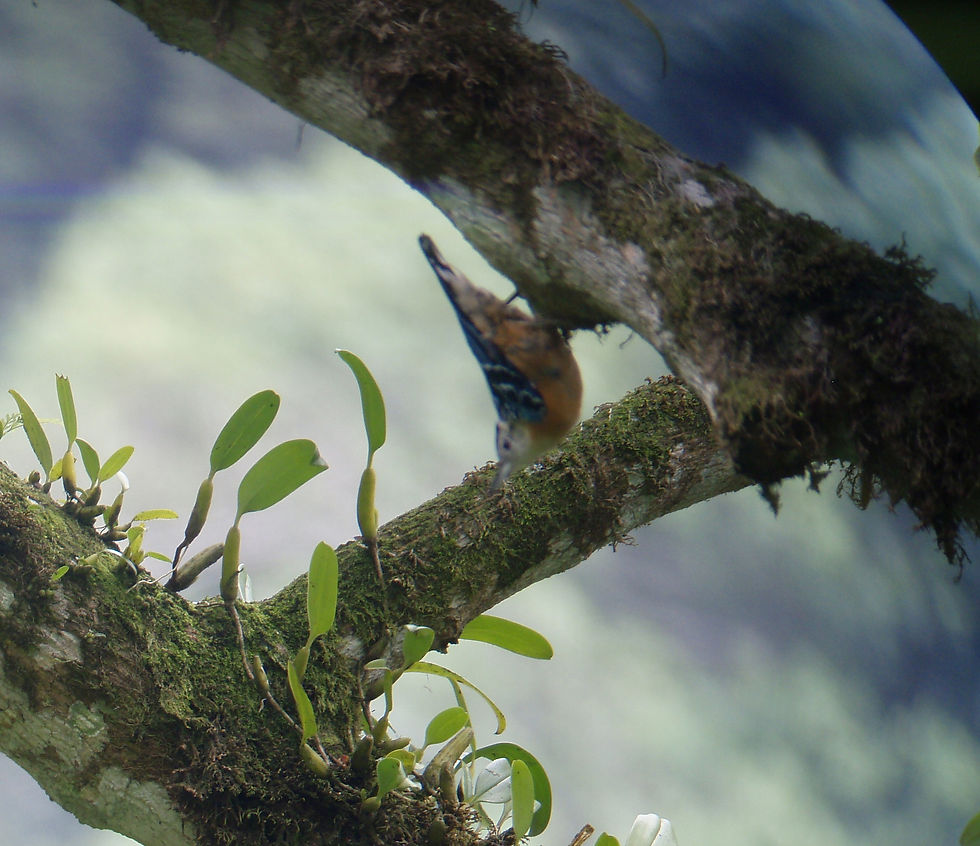
Bompur also offered some life affirming bird encounters; Golden-throated Barbet, Golden Babbler, Scarlet Finch and Beautiful Nuthatch all tipped the awesome scales. We also encountered family firsts with flower peckers and wren babblers making the trip list.


I recall one day after a particularly intense six hours trek in search of Ward’s Trogon I procured a bottle of Old Monk Rum from one of our guides. This coupled with some expedition beer caused bedlam. I am told I was much like a comet burning bright before quickly fizzling out to be tucked up in bed by 7pm!

Leaving Eaglenest we had to retrace our steps back to Nameri as the route straight into Assam was closed by the army due to an unmovable landslide! Worryingly during our stay higher up the remaining exit route was also subject to a landslide and as such there was considerable uncertainty of our leaving!
We did manage our exit brushing steep ravines, driving over landslides and part built roads, which the army was literally bulldozing in place before letting the next vehicles pass! We were fortunate in a 4X4 jeep; others seeking to pass were crammed six into Fiat Cinquecento-like vehicles with their possessions strapped atop. All power to them! All the groups we watched made it over the worst rubble strewn sections via a few wheel spins, pushes and violent bounces!

Despite the late date in our tour we were still adding new birds with Bar-winged Wren Babbler and Cuckoo Dove falling at the eleventh hour. Finding ourselves back in Nameri and without such physical obstacles as landslides between us and Guwahati airport the team relaxed. We enjoyed the replenished beer supply along with one of the birds of the trip, a Brown Hawk Owl literally right outside our tent! Our last day in the uplands was marked by amazing weather with blue skies and amazing visibility. We were able to view across the border into Tibet with Lob Sang pointing out specific peaks, a tantalising view!
The journey back to Guwahati was intense with poor roads, stifling heat and clogging dust. Adding to the drama was a funeral procession with the recently deceased passing our jeep held aloft, right an eye level. Once in the comparative civilization of Guwahati we indulged in shaves and haircuts.
I feel the whole group enjoyed Guwahati, with Black Kites, House Crows and sparrows constant companions as you move through the streets.


Delhi however, held no such charm and was unpleasantly fraught, perhaps intensified by the contrast with the remoteness and natural beauty of our preceeding weeks. That said, Delhi did deliver Egyptian Vulture and Shikra onto our trip lists.
Not even the culture shock of Delhi could dull our spirits and the sheer invigoration of our tour at large. It remains the single most extreme, beautiful, relaxing and exciting trip of my life - one I think about regularly.


Comments